
Cauvery Water Dispute
Often referred to as the "Dakshin Ganga" (Ganges of the South), the Cauvery River is a crucial lifeline for southern India. The ongoing Cauvery Water Dispute over its waters remains one of India's oldest and most complex inter-state river water conflicts. This dispute primarily involves the states of Karnataka, Tamil Nadu, Kerala, and the Union Territory of Puducherry.
Why is the Cauvery Water Dispute in the News Today?
The river water sharing conflict has recently flared up again over Karnataka's proposed Mekedatu Balancing Reservoir Project. Tamil Nadu has strongly urged the Central Government to deny any statutory or administrative approvals unless the Mekedatu project strictly complies with the 2007 Cauvery Water Disputes Tribunal (CWDT) Award and the definitive 2018 Supreme Court judgment.
Geographical Overview of the Cauvery River Basin
Understanding the geography of the river is essential to grasping the scope of the Cauvery Water Dispute:
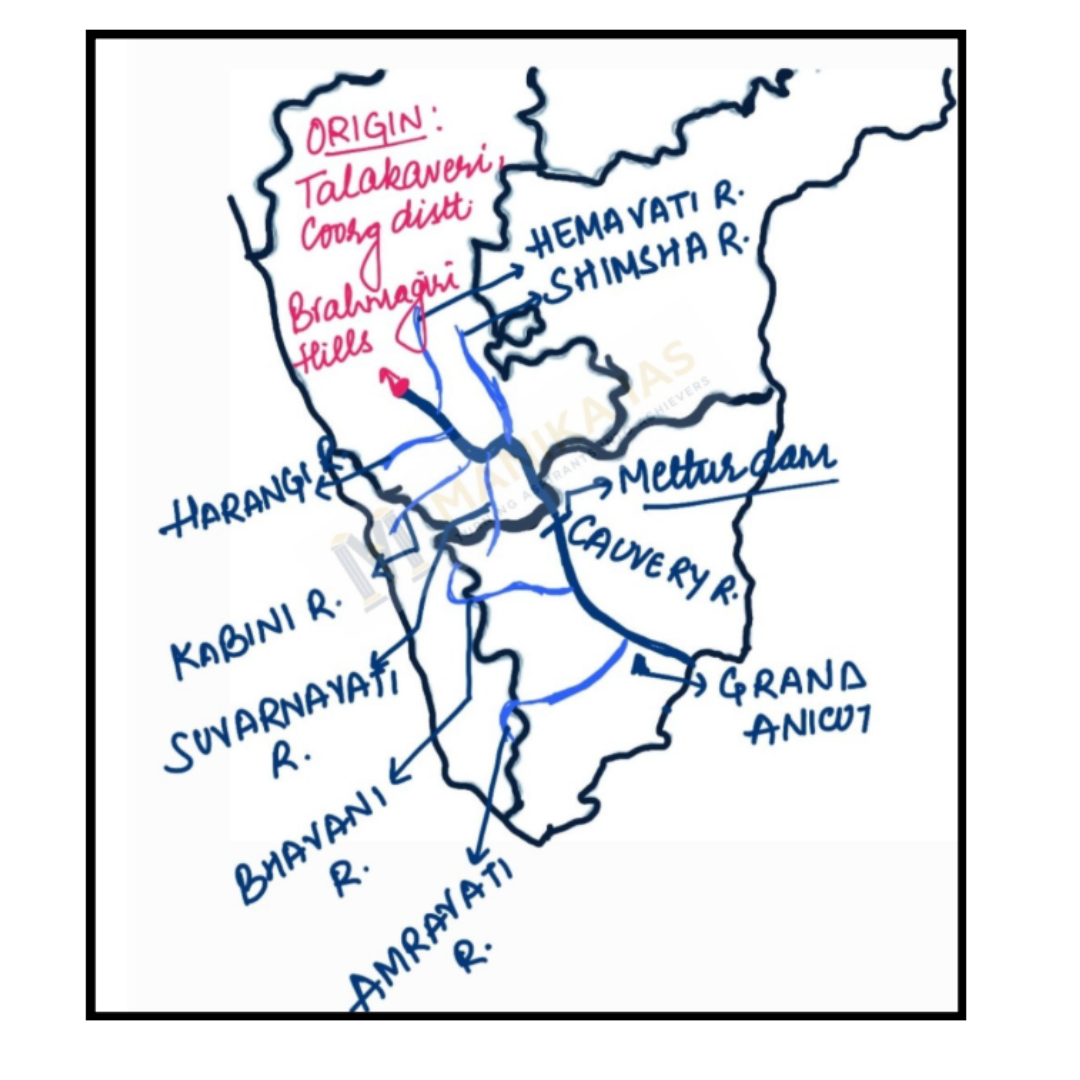
Origin: The river rises at Talakaveri in the Brahmagiri Hills of the Western Ghats (Kodagu district, Karnataka).
Length: It flows for approximately 800 km eastward into the Bay of Bengal.
Basin States Involved: Karnataka, Tamil Nadu, Kerala, and Puducherry.
Major Tributaries:
Left Bank Tributaries: Harangi, Hemavati, Shimsha, Arkavathi.
Right Bank Tributaries: Lakshmantirtha, Kabini, Suvarnavati, Bhavani, Noyyal, Amaravati.
Key Dams on the Cauvery: Krishnarajasagar (KRS), Mettur Dam, Kabini, Hemavati, and Harangi.
Mouth of the River: Forms a highly fertile agricultural delta before emptying into the Bay of Bengal near Poompuhar (Tamil Nadu).
Historical Timeline of the Inter-State River Water Dispute
The roots of the Cauvery conflict stretch back over a century, marked by key agreements and tribunal formations:
1892 & 1924 Agreements: Colonial-era water-sharing pacts between the Madras Presidency and the Princely State of Mysore. The crucial 1924 agreement allowed for dam construction (such as KRS and Mettur) and was valid for a period of 50 years.
1974 Expiration: The 1924 agreement expired; Karnataka subsequently began claiming a larger share of the water, leading to renewed inter-state friction.
1990 CWDT Formation: The Central Government constituted the Cauvery Water Disputes Tribunal (CWDT)under the Inter-State River Water Disputes Act, 1956.
2007 Tribunal Award: The CWDT delivered its final award, allocating water based on the specific basin requirements of each state.
2013 Legal Enforcement: The Central Government officially notified the CWDT's final award in the Official Gazette, making the water allocations legally enforceable.
2018 Supreme Court Verdict: The Supreme Court of India delivered its final, binding verdict, which modified the tribunal's earlier water allocations.
The Landmark 2018 Supreme Court Judgment on the Cauvery Dispute
The Supreme Court laid down a permanent, equitable framework for river water sharing, establishing several critical legal precedents:
National Resource Principle: The Court firmly established that inter-state river water is a national resource, declaring that no single state can claim exclusive ownership over the river.
Revised Water Allocations:
Karnataka: Share was increased by 14.75 TMC (totaling 284.75 TMC) specifically to account for Bengaluru's rapidly growing drinking water requirements.
Tamil Nadu: Share was reduced from the Tribunal's 419 TMC to 404.25 TMC.
Kerala & Puducherry: Allocations remained entirely unchanged at 30 TMC and 7 TMC, respectively.
Mandatory Release Directives: Karnataka was directed to ensure the annual release of 177.25 TMC of water to Tamil Nadu, measured at the Biligundlu point.
Institutional Mechanism: The Court ordered the creation of the CWMA and CWRC to enforce and monitor the verdict.
Institutional Framework: The Role of the CWMA & CWRC
Established in June 2018, the Cauvery Water Management Authority (CWMA) and the Cauvery Water Regulation Committee (CWRC) serve as the statutory bodies tasked with managing the dispute:
Implementation: Enforcing the CWDT Award and the 2018 Supreme Court judgment.
Monitoring: Tracking reservoir levels, rainfall patterns, and water inflows across the entire basin.
Scheduling: Ensuring monthly water releases are executed according to the legally approved schedule.
Conflict Resolution: Resolving ongoing operational friction between the riparian basin states.
The Mekedatu Project Controversy Explained
The Mekedatu project is the current flashpoint in the Cauvery Water Dispute:
What is the Mekedatu Project? A proposed balancing reservoir and drinking water project initiated by Karnataka at Mekedatu (Ramanagara district) on the Cauvery River.
Project Capacity & Estimated Cost: The project proposes a storage capacity of ~67.16 TMC and a 400 MW hydropower generation capacity, with an estimated cost of around ₹9,000 crore.
Karnataka's Stance: Karnataka argues the project is essential to meet the urgent drinking water needs of Bengaluru and generate power, claiming it will not affect the mandated water release to Tamil Nadu.
Tamil Nadu's Stance: Tamil Nadu strongly opposes the project, fearing it will illegally impound river flow and deprive downstream farmers in the Cauvery delta of their legally allocated share, especially during distress years with deficient rainfall.
Constitutional & Legal Framework for River Disputes
The resolution of the Cauvery Water Dispute relies on specific Indian constitutional provisions and national laws:
Article 262 of the Constitution: Empowers Parliament to legislate for the adjudication of inter-state river water disputes. Crucially, it also allows Parliament to bar the Supreme Court and other courts from exercising jurisdiction over these specific disputes.
Entry 56 (Union List): Grants the Central Government the constitutional authority to regulate and develop inter-state rivers and river valleys in the broader public interest.
Inter-State River Water Disputes Act, 1956: Enacted under Article 262, this act provides the legal mechanism for creating specific Water Disputes Tribunals (such as the CWDT).
River Boards Act, 1956: Enacted to facilitate the regulation and development of inter-state river basins (Note: no River Board has actually been constituted under this Act to date).
Resources for Prelims 2027
Places in News weekly Daily Current Affairs Prelims Test Series 2027