
India's Healthcare Revolution: Out-of-Pocket Health Spending Drops 21% — What Every Indian Family Needs to Know
That picture is now changing — and the data proves it.
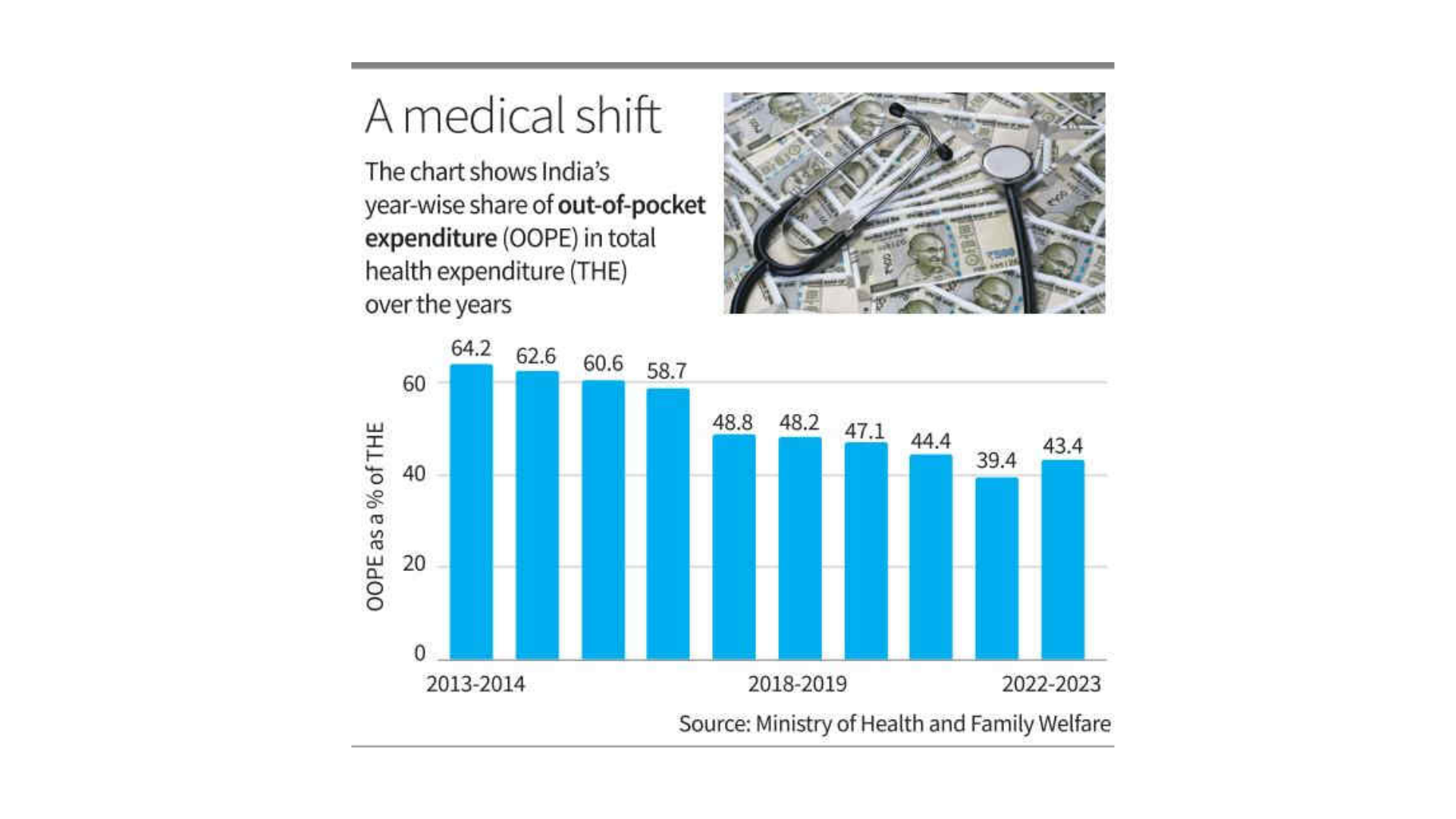
The National Health Accounts (NHA) 2022-23, released by the Union Ministry of Health and Family Welfare, confirms that OOPE as a percentage of total health expenditure (THE) has declined to 43.4% — down from 64.2% in 2013-14. That is a reduction of 21 percentage points in a single decade, and it represents one of the most significant shifts in India's public health financing history.
Key Statistics at a Glance
- OOPE in 2013-14: 64.2% of total health expenditure
- OOPE in 2022-23: 43.4% of total health expenditure
- Decline: 21 percentage points over 10 years
- Ayushman Arogya Mandir centres: 1.8 lakh+ operational across India
- Per capita government health spend: ₹1,042 (2013-14) → ₹2,786 (2022-23)
- Private health insurance share: 3.4% (2013-14) → 9.2% (2022-23)
- Social security health spend: 6% (2013-14) → 9.9% (2022-23)
- Government health spend as % of GDP: 1.15% → 1.43%
What Is Out-of-Pocket Expenditure — and Why Does It Matter?
Out-of-pocket expenditure refers to money paid directly by individuals at the point of receiving healthcare — medicines, consultation fees, diagnostic tests, surgery charges — that is not covered by any insurance or government programme.
It is the most regressive form of health financing. The less you earn, the greater the share of your income it consumes. Research consistently shows that high OOPE pushes 3 to 7 percent of Indian households below the poverty line every single year. A single hospitalisation for a serious illness can erase years of savings for a middle-income household.
Reducing OOPE is therefore not merely a health metric. It is one of the most powerful anti-poverty tools a government can deploy.
Year-wise OOPE Trend: A Decade of Progress
Year | OOPE as % of Total Health Expenditure |
|---|---|
2013-14 | 64.2% |
2014-15 | 62.6% |
2015-16 | 60.6% |
2016-17 | 58.7% |
2018-19 | 48.8% |
2019-20 | 48.2% |
2020-21 | 47.1% |
2021-22 | 39.4% |
2022-23 | 43.4% |
Source: Ministry of Health and Family Welfare, NHA 2022-23
The data shows a clear, sustained downward trend from 2013 through 2021-22, with a slight rise in 2022-23 explained separately below.
The Ayushman Factor: How 1.8 Lakh Wellness Centres Changed Everything
No single factor explains the OOPE decline better than the operationalisation of Ayushman Arogya Mandir (AAM) wellness centres — over 1.8 lakh of them spread across India, providing free preventive and curative healthcare directly in communities.
These centres are not mere referral desks. Each one delivers a comprehensive package of 12 healthcare services entirely free of charge:
1. Reproductive and Child Health Antenatal care, immunisation, family planning, and newborn care — services that previously required costly private clinic visits.
2. Communicable and Non-Communicable Disease Management Diabetes and hypertension screening, treatment, and monitoring — eliminating repeat specialist fees for chronic patients.
3. Free Drugs and Diagnostics Medicines and tests provided at zero cost, directly addressing the single biggest driver of OOPE: pharmaceutical purchases.
4. Teleconsultations Remote access to doctors, reducing the need for expensive urban hospital trips, especially for rural populations.
5. Preventive Care and Wellness Sessions Early intervention to reduce the episodes of illness that eventually require costly hospitalisation.
Government Health Investment: The Numbers Behind the Shift
The decline in OOPE does not happen in isolation. It is the direct result of the government spending significantly more so that citizens spend significantly less. The NHA 2022-23 data shows rising investment across every key metric:
GDP Share Government health expenditure has risen from 1.15% of GDP in 2013-14 to 1.43% in 2022-23. During COVID-19 (2021-22), it peaked at 1.84% of GDP as emergency health funding surged.
General Expenditure Share Health's share of total government expenditure has grown from 3.78% to 4.89% over the same period — meaning health is claiming a bigger share of every rupee the government spends.
Per Capita Spend Government health expenditure per person has grown nearly 2.7 times — from ₹1,042 to ₹2,786 between 2013-14 and 2022-23.
Social Security Social security expenditure on health has risen from 6% to 9.9% of total health expenditure — a sign of a maturing health protection ecosystem.
Ayushman Bharat PMJAY: Insurance for 55 Crore Indians
Alongside the wellness centre network, the Pradhan Mantri Jan Arogya Yojana (PMJAY) — the insurance arm of Ayushman Bharat — provides secondary and tertiary hospitalisation coverage of up to ₹5 lakh per family per year to economically vulnerable populations.
Investment in AB-PMJAY has seen a 4.4-fold increase since 2013-14. According to NITI Aayog Member Dr. V.K. Paul, the scheme has generated savings exceeding ₹1 lakh crore for Indian households that would otherwise have paid these bills entirely out of pocket.
Recent expansions include:
- Coverage extended to all senior citizens aged 70 years and above, regardless of income level
- Free dialysis services (launched 2015-16) have benefited over 25 lakh patients
- Pradhan Mantri Bhartiya Janaushadhi Pariyojana (PMBJP) providing quality generic medicines at a fraction of branded prices
Why 2022-23 Shows a Slight Uptick from the 2021-22 Low
The 2021-22 figure of 39.4% was a historic low — partially because COVID-19 lockdowns suppressed routine healthcare utilisation across India. As normalcy returned in 2022-23, healthcare consumption rebounded, pushing the figure back to 43.4%.
Additionally, increased government spending during the pandemic was a one-time measure. As NITI Aayog has noted, the underlying structural trend remains firmly downward. The decadal trajectory is unambiguously positive.
Private Health Insurance: India's Third Pillar Is Rising Fast
One of the most commercially significant findings in NHA 2022-23 is the rapid growth of private health insurance. Its share of total health expenditure has grown from 3.4% in 2013-14 to 9.2% in 2022-23 — nearly tripling in a decade.
This reflects a growing middle class that is both aware of health risks and willing to invest in coverage — a profound shift in health-seeking behaviour. Combined with government coverage, India is developing the multi-layered protection system that characterises high-performing health economies globally.
Challenges That Remain
- The data is unambiguously positive, but analysts caution against declaring victory too early.
- India's National Health Policy 2017 set a target of government health spending reaching 2.5% of GDP by 2025. At 1.43%, the country remains well short of that goal.
- Urban-rural disparities in access persist. The doctor-patient ratio stands at approximately 1:1,100 nationally, heavily skewed toward cities (1:400 in urban areas).
- A nuanced counter-data point also exists: the Consumer Expenditure Survey (CES) 2022-23 shows that OOPE as a share of household consumption expenditure has marginally increased — from 5.5% to 5.9% in rural areas and 6.9% to 7.1% in urban areas. This suggests that while the relative burden is improving, absolute health spending per household is rising — a reflection of growing demand for quality care.
The Road Ahead: What Universal Health Coverage Looks Like for India
India's trajectory points toward a health system where financial catastrophe due to illness becomes increasingly rare. The combination of:
- Free primary care at 1.8 lakh community wellness centres
- Hospitalisation insurance for over 55 crore citizens
- Tripling private insurance coverage
- Near-tripling of per capita government health spend
...creates the conditions for OOPE to fall below the 40% mark sustainably — and eventually approach the WHO-recommended 20% threshold that defines a truly protective health system.
The NHA 2022-23 is the 10th report in the series, prepared using the internationally accepted System of Health Accounts (SHA) 2011 framework developed by WHO. It is compiled by the National Health Accounts Technical Secretariat (NHATS) at the National Health Systems Resource Centre, Ministry of Health and Family Welfare.
Frequently Asked Questions (FAQ)
Q1: What is out-of-pocket expenditure (OOPE) in healthcare?
Out-of-pocket expenditure refers to direct payments made by individuals for healthcare services — medicines, diagnostics, consultation fees, and hospitalisation costs — that are not reimbursed by any insurance or covered by any government scheme. It is the most financially damaging form of health spending because it hits individuals hardest at the moment they can least afford it: when they are sick. High OOPE is globally recognised as one of the leading drivers of medical poverty.
Q2: By how much has OOPE declined in India?
According to the NHA 2022-23 report, OOPE as a share of total health expenditure has declined from 64.2% in 2013-14 to 43.4% in 2022-23 — a reduction of 20.8 percentage points, or approximately 21%, over a decade. This is one of the largest sustained reductions in out-of-pocket health spending recorded by any large economy in this period.
Q3: What is causing the decline in OOPE in India?
The decline is driven by three interconnected forces. First, the operationalisation of over 1.8 lakh Ayushman Arogya Mandir wellness centres providing free drugs, diagnostics, and 12 healthcare services at the community level. Second, the expansion of Ayushman Bharat PMJAY insurance to over 55 crore beneficiaries for secondary and tertiary hospitalisation. Third, a sustained increase in government health investment — per capita spend has grown 2.7 times between 2013-14 and 2022-23.
Q4: What does the NHA 2022-23 report cover?
The National Health Accounts 2022-23 is the 10th report in the annual series released by the Union Ministry of Health and Family Welfare. It tracks all health expenditure flows in India — government spending, private insurance, out-of-pocket payments, and social security — using the WHO's System of Health Accounts (SHA) 2011 framework. It is prepared by the National Health Accounts Technical Secretariat (NHATS) at the National Health Systems Resource Centre.
Q5: Is 43.4% OOPE still too high?
Yes, by international standards it remains elevated. The World Health Organization recommends that OOPE should fall below 20% of total health expenditure for a health system to be considered truly protective against financial catastrophe. India's progress over the past decade is significant, but reaching the WHO benchmark will require sustained investment in public health infrastructure, further expansion of insurance coverage, and continued reduction in medicine costs through generic drug programmes.
Q6: What is Ayushman Arogya Mandir and how does it reduce OOPE?
Ayushman Arogya Mandir (AAM) is the network of community wellness centres under the Ayushman Bharat programme. Each centre offers 12 categories of free healthcare services including reproductive health, child health, management of communicable and non-communicable diseases, free medicines, free diagnostics, and teleconsultations. By bringing these services to local communities at zero cost, the centres directly reduce the need for households to pay out of pocket for routine and preventive care.
Q7: How much has India's government health spending grown?
Government health expenditure as a percentage of GDP has grown from 1.15% in 2013-14 to 1.43% in 2022-23. In per capita terms, it has grown nearly 2.7 times — from ₹1,042 to ₹2,786. The health budget overall grew 85% between 2017-18 (₹47,353 crore) and 2024-25 (₹87,657 crore). During COVID-19 in 2021-22, government health spending temporarily reached 1.84% of GDP.
Q8: What is the role of private health insurance in reducing OOPE?
Private health insurance acts as the third pillar of India's health protection system — complementing government schemes and public facilities. Its share of total health expenditure has nearly tripled from 3.4% in 2013-14 to 9.2% in 2022-23. As more Indians purchase health insurance, the financial risk of hospitalisation is transferred away from individual households to insurance pools — directly reducing OOPE at the time of illness.
Q9: What is Ayushman Bharat PMJAY and who is covered?
Pradhan Mantri Jan Arogya Yojana (PMJAY), the insurance arm of Ayushman Bharat, provides hospitalisation coverage of up to ₹5 lakh per family per year for secondary and tertiary care. It covers approximately 55 crore individuals — around 40% of India's population — prioritising economically vulnerable families. In a recent expansion, all senior citizens aged 70 years and above were included in PMJAY coverage regardless of their income level.
Q10: What is India's target for government health spending?
The National Health Policy 2017 set a target of government health expenditure reaching 2.5% of GDP by 2025. The current level is 1.43% — meaning India still needs to significantly scale up public investment to meet its own policy commitment. Closing this gap is considered essential to sustainably reducing OOPE to WHO-recommended levels and achieving genuine universal health coverage.
Sources: Ministry of Health and Family Welfare, National Health Accounts 2022-23; NITI Aayog; National Health Systems Resource Centre (NHATS); Press Information Bureau, Government of India.