
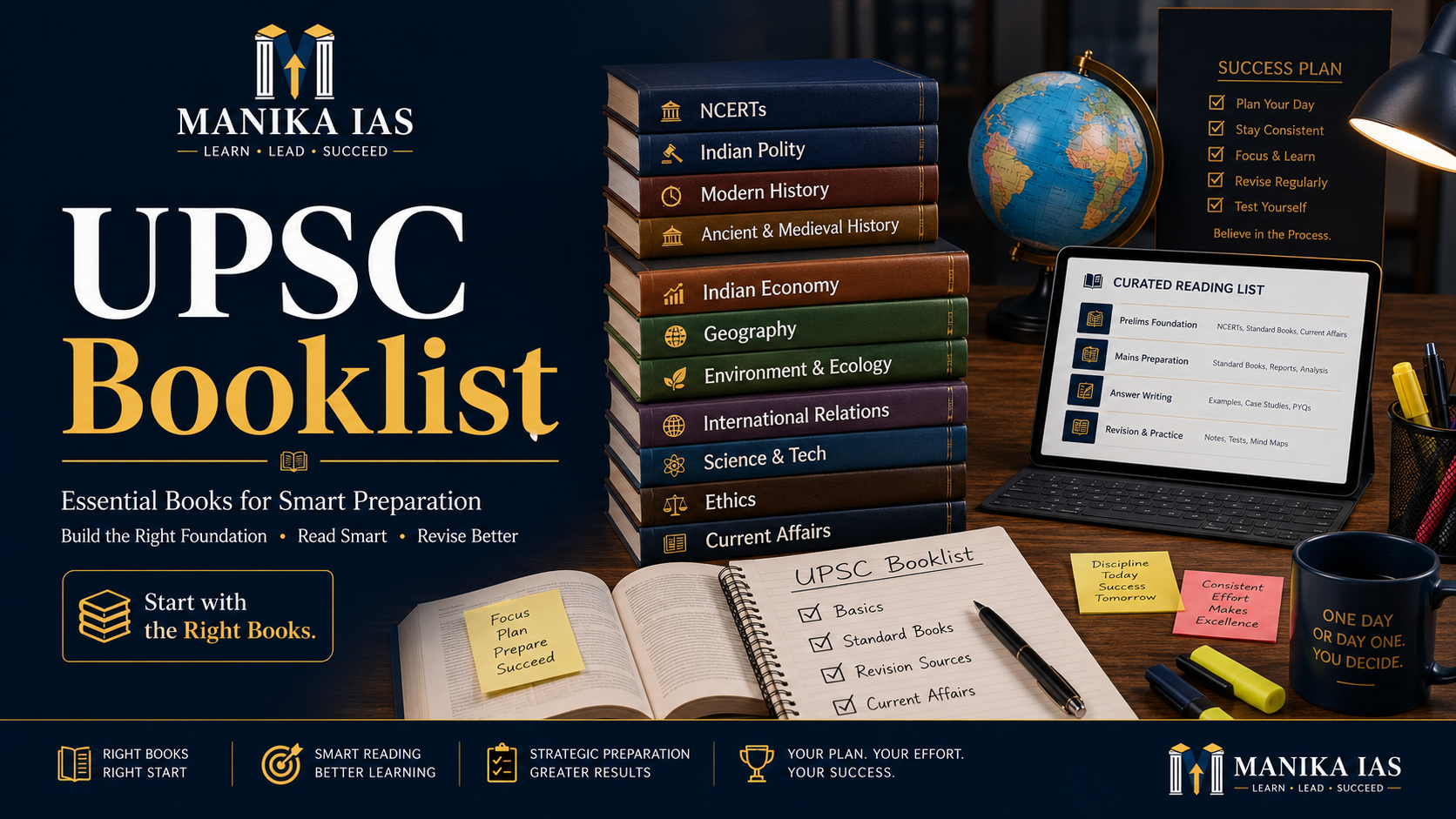
The Ultimate UPSC Booklist: Which NCERTs and Standard Books Do You Actually Need?
The harsh reality? Buying every book on the market won't clear the exam. Reading a curated list of books multiple times will.
At Manika IAS, we champion a "Qualifying vs. 100/100" educational philosophy. The UPSC Civil Services Examination is not about mastering every single page of every book; it is about strategic simplification. You only need enough targeted knowledge to qualify and secure your rank.
Here is the definitive, no-nonsense booklist covering the strictly necessary NCERTs and standard reference books to streamline your preparation.
Phase 1: The Strictly Necessary NCERTs
NCERTs form the conceptual bedrock of your preparation. However, you do not need to read every NCERT from Class 6 to 12. Focus only on the ones that build a direct foundation for the UPSC syllabus.
1. History
Ancient India: Class 11 (Old NCERT by R.S. Sharma)
Medieval India: Class 11 (Old NCERT by Satish Chandra)
Modern India: Class 12 (Old NCERT by Bipan Chandra)
Art & Culture: Class 11 (An Introduction to Indian Art)
2. Geography
Geography NCERTs are non-negotiable and are often directly sourced for Prelims questions.
Class 11: Fundamentals of Physical Geography & India – Physical Environment (Crucial)
Class 12: Fundamentals of Human Geography & India – People and Economy
3. Polity
Class 11: Indian Constitution at Work (Essential for understanding the philosophy of the Constitution before jumping into standard books).
Class 11: Political Theory (Good for basic concepts like Liberty, Equality, Justice for GS Paper 2 and GS Paper 4).
4. Economy
Class 11: Indian Economic Development
Class 12: Introductory Macroeconomics (Skip the complex math; focus on concepts like banking, inflation, and national income).
5. Science & Environment
Class 6 to 10: General Science (Read selectively for basic biological and physical concepts).
Class 12 Biology: Only the last four chapters (Chapters 13-16) for Ecology and Environment.
Phase 2: The Core Standard Books
Once your NCERT foundation is solid, upgrade to these standard reference books. Apply the "Qualifying vs. 100/100" mindset here: focus on high-yield chapters and link them directly to the syllabus and previous year questions (PYQs).
| Subject | Recommended Standard Book | Strategy & Focus Areas |
|---|---|---|
| Indian Polity | Indian Polity by M. Laxmikanth | The undisputed bible for Polity. Focus heavily on Fundamental Rights, Parliament, Judiciary, and Constitutional Bodies. |
| Modern History | A Brief History of Modern India by Spectrum | Concise and exam-oriented. Pay special attention to the summary pages at the end of each chapter for quick Prelims revision. |
| Geography & Map Work | Certificate Physical and Human Geography by G.C. Leong | Essential for physical geography concepts. For Mapping: Rely strictly on the Manika IAS Places in News book and the Map Bundle PDF to cover dynamic, current affairs-linked geography efficiently. |
| Indian Economy | Indian Economy By Manika IAS | Supplement this with the Union Budget, Economic Survey, and daily current affairs. Economy is highly dynamic. |
| Environment | Environment by Manika IAS | Focus on biodiversity, climate change treaties, and national parks/wildlife sanctuaries. |
| Art & Culture | Indian Art and Culture by Nitin Singhania | Do not try to memorize the whole book. Focus on architecture, classical dances, paintings, and religion. |
| International Relations | Current Affairs & Newspapers | No single static book is sufficient. Rely on The Hindu or The Indian Express and monthly current affairs compilations. |
Having the right books is only 10% of the battle. How you consume them is the other 90%.
Syllabus First, Book Second: Never read a standard book cover-to-cover like a novel. Always keep a copy of the UPSC micro-syllabus next to you. If a chapter doesn't map to a syllabus point, skip it.
The 3-Reading Rule: * First reading: Read like a story to understand the flow. No highlighters.
Second reading: Highlight key concepts and connect them to PYQs.
Third reading: Make crisp, concise micro-notes that you can revise the week before the exam.
Master Current Affairs Integration: Static books give you the background, but current affairs give you the context. When you read about the Election Commission in Laxmikanth, you must immediately link it to the recent Chief Election Commissioner appointment bills in the news.
Navigate the Syllabus with Expert Mentorship
Even with a streamlined booklist, the sheer volume of the UPSC syllabus can cause decision fatigue. Reading the books is one thing, but knowing how to extract exam-relevant points, write effective Mains answers, and manage your daily timetable is where most aspirants struggle.
To bridge this gap, we offer the Personalised Mentorship Program (PMP) at Manika IAS.
The PMP is designed to cut through the noise. Instead of leaving you alone with a stack of books, our mentors provide micro-scheduled study plans, hold you accountable, and apply our strategic simplification philosophy to ensure your hard work translates directly into marks.
Stop endlessly searching for the perfect resources and start studying the right ones. Build your foundation, trust your selected books, and let guided mentorship take you across the finish line.
Keywords: UPSC booklist, best NCERTs for UPSC, standard books for UPSC, Indian Polity by Laxmikanth, UPSC Modern History Spectrum, Manika IAS, UPSC preparation strategy.